
Climate Justice Timeline
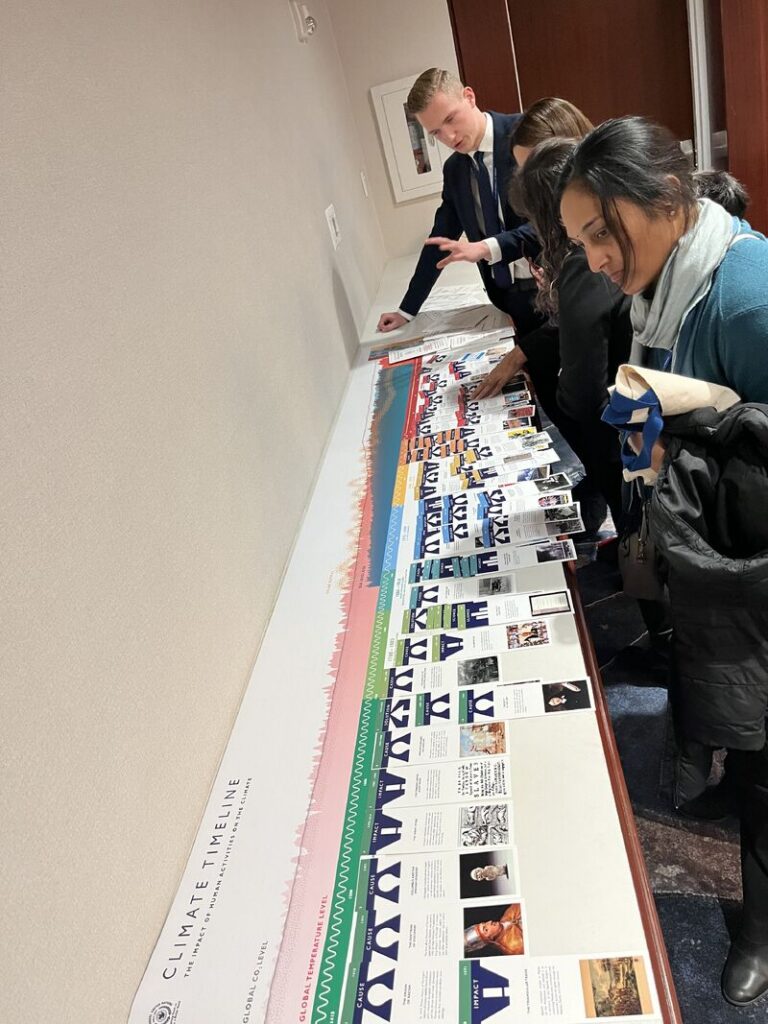
The Climate Justice Timeline invites learners to understand the climate crisis as a historical, systemic, and justice-centered challenge.
It supports big-picture, systems thinking and student agency by situating today’s climate emergency within a long arc of human choices, power structures and values
AUTHOR’S NOTE
This timeline is not an exhaustive list of the climate crisis. It reflects our perspective and does not claim to represent all viewpoints within this incredibly complex history. We present this timeline and the supporting materials as an opportunity to reflect on where we are and how we got here, as a means to prepare our students for the world they will inherit.
To borrow an oft repeated phrase: this is the finger pointing at the moon, not the moon itself.
We strongly encourage teachers to select the cards that are appropriate for their classroom context. A set of blank physical cards is included, along with QR codes to download digital templates for all four card types. Teachers and students are encouraged to create their own cards adding local, cultural or contemporary events for this timeline.
These materials have an open frame, one that can adapt and shift across classrooms, students, regions, and environments.
ARTIST’S STATEMENT
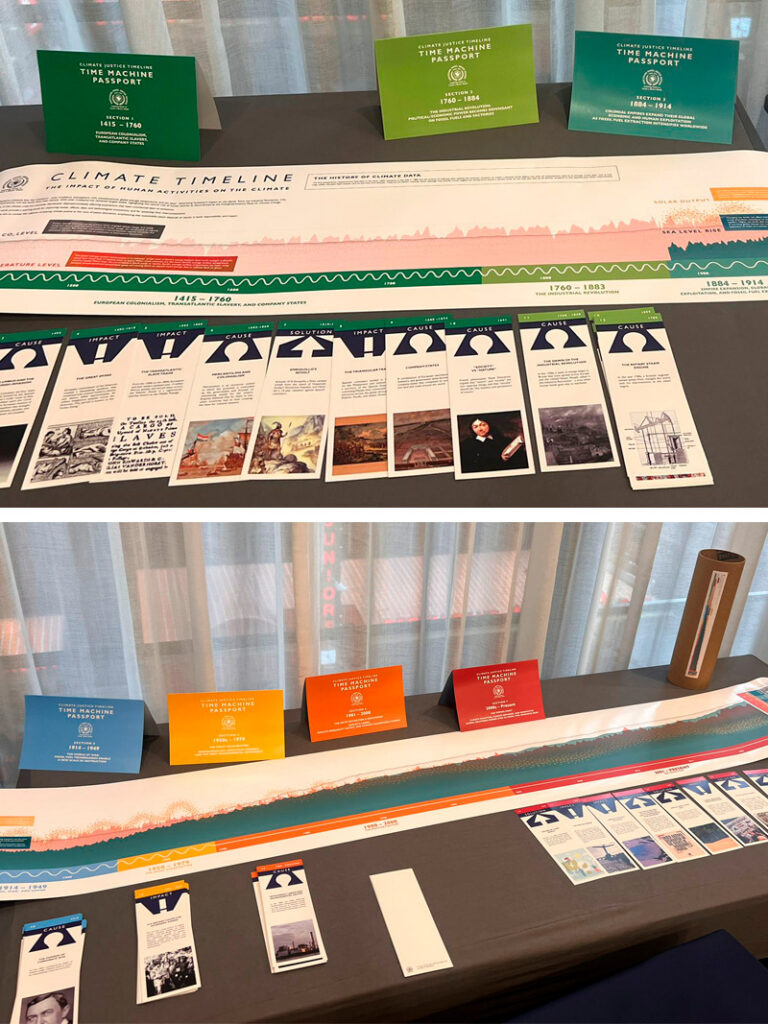
This infographic presents four key indicators – solar irradiance, atmospheric CO₂ concentrations, global average temperature, and sea level – illustrating humanity’s impact on the planet. Since the Industrial Revolution, CO₂ levels, temperatures, and sea levels have risen sharply, while solar irradiance has remained largely stable, highlighting the central role of human activity as documented by the Intergovernmental Panel on Climate Change.
The impacts of the climate crisis are unevenly distributed, disproportionately affecting populations that have contributed least to emissions.
The included cards provide a starting point for exploring causes, effects, data, and technological innovations, and for assessing their interconnections.
Colors and lines aim to convey the urgency of placing climate justice at the core of peace education, emphasizing that sustainable peace depends on equity in both responsibility and impact.
“Transition is inevitable. Justice is not.”
Movement Generation
Card Image Credits
- 1 Free to use
- 2 Public domain image
- 3 Free to use: Christopher Columbus (1451–1506). Epistola Christofori Colom (Letters of Christopher Columbus). Rome: Stephan Plannck, after April 29,1493. Rare Book and Special Collections Division, Library of Congress (048.00.00, 048.00.01, 048.00.02, 048.00.03)
- 4 Wikimedia Commons/Free to use
- 5 Free to use
- 6 Johan Herman Isings/Free to use
- 7 16th Century Painting Depicting El Indio Enriquillo
- 8 Public domain image
- 9 Wikimedia Commons/Free to use
- 10 Public domain image
- 11 M0003525: Newspaper cutting of the landscape of potteries amongst factories. Source: Wellcome Collection
- 12 Robert H. Thurston/Free to use
- 13 Public domain image
- 14 Public domain image
- 15 Public domain image
- 16 Boston Public Library/Unsplash/Free to use
- 17 Free to use
- 18 Free to use
- 19 Wikimedia Commons/Free to use
- 20 Wikimedia Commons/Free to use
- 21 Public domain image
- 22 Public domain image
- 23 Free to use/Source: Kheel Center
- 24 Wikimedia Commons/Free to use
- 25 Wikimedia Commons/Free to use
- 26 Wikimedia Commons/Free to use
- 27 Wikimedia Commons/Free to use
- 28 Wikimedia Commons/Public domain
- 29 Freepik/Free to use
- 30 Pexels/Free to use
- 31 Youth for a Better World, Inc. D/B/A Montessori Model United Nations
- 32 UN Photo/CC0I
- 33 Generated with AI
- 34 Wikimedia Commons/Public domain
- 35 Public domain image
- 36 Public domain image
- 37 AMI
- 38 Public domain image/1953 Iran coup
- 39 Unseen Histories/Unsplash/Free to use
- 40 Konstant Loubier/Unsplash/Free to use
- 41 American Public Power Association/Unplash/Free to use
- 42 Michel Isamuna/Unsplash/Free to use
- 43 Pixabay/Free to use
- 44 Wikimedia Commons/Free to use 45 Public domain
- 46 Creative Commons
- 47 Freepik/Free to use
- 48 Wikimedia Commons/Free to use
- 49 Freepik/Free to use
- 50 Freepik/Free to use
- 51 Ella Ivanescu/Unpsplash/Free to use
- 52 Freepik/Free to use
- 53 Wikimedia Commons/Public domain
- 54 Intergovernmental Panel on Climate Change/Public domain
- 55 Office of the United Nations High Commissioner for Human Rights/Public domain
- 56 Wikimedia Commons/Free to use
- 57 Brice Cooper/Unsplash/Free to use
- 58 Wikimedia Commons/Free to use
- 59 Freepik/Free to use
- 60 Wikimedia Commons/Free to use
- 61 Markus Spiske/Unsplash/Free to use
- 62 Freepik/Free to use
- 63 Staff Sgt. Christopher Willis/Wikimedia Commons/Public domain 64 NASA/GSFC/LaRC/JPL, MISR Team
- 65 United Nations
- 66 Generated with AI
- 67 Wikimedia Commons/Free to use
- 68 Mirna Wabi-Sabi/Unpsplash/Free to use
- 69 Ashwin Vaswani/Unsplash/Free to use
- 70 Dibakar Roy/Unsplash/Free to use
- 71 Dedale/Unsplash/Free to use
- 72 Creative Commons Attribution-ShareAlike
- 73 Creative Commons Attribution-ShareAlike
- 74 Leonardo Basso/Unsplash/Free to use
- 75 Dmytro Tolokonov/Unsplash/Free to use
- 76 Mika Baumeister/Unsplash/Free to use
- 77 UN/https://www.un.org/sustainabledevelopment/The content of this publication has not been approved by the United Nations and does not reflect the views of the United Nations or its officials or Member States.
- 78 Wade Austin Ellis/Unsplash/Free to use
- 79 Vladimir Fedotov/Unsplash/Free to use
- 80 Janne Leimola/Unsplash/Free to use
- 81 Iqro Rinaldi/Unsplash/Free to use
© Youth for a Better World Inc. All rights reserved 2026.
Artwork and artist statement by Chiara Arnone | arnonechiara.info
The Climate Crisis Timeline is used with permission from the Zinn Education Project.
© Zinn Education Project. All rights reserved.